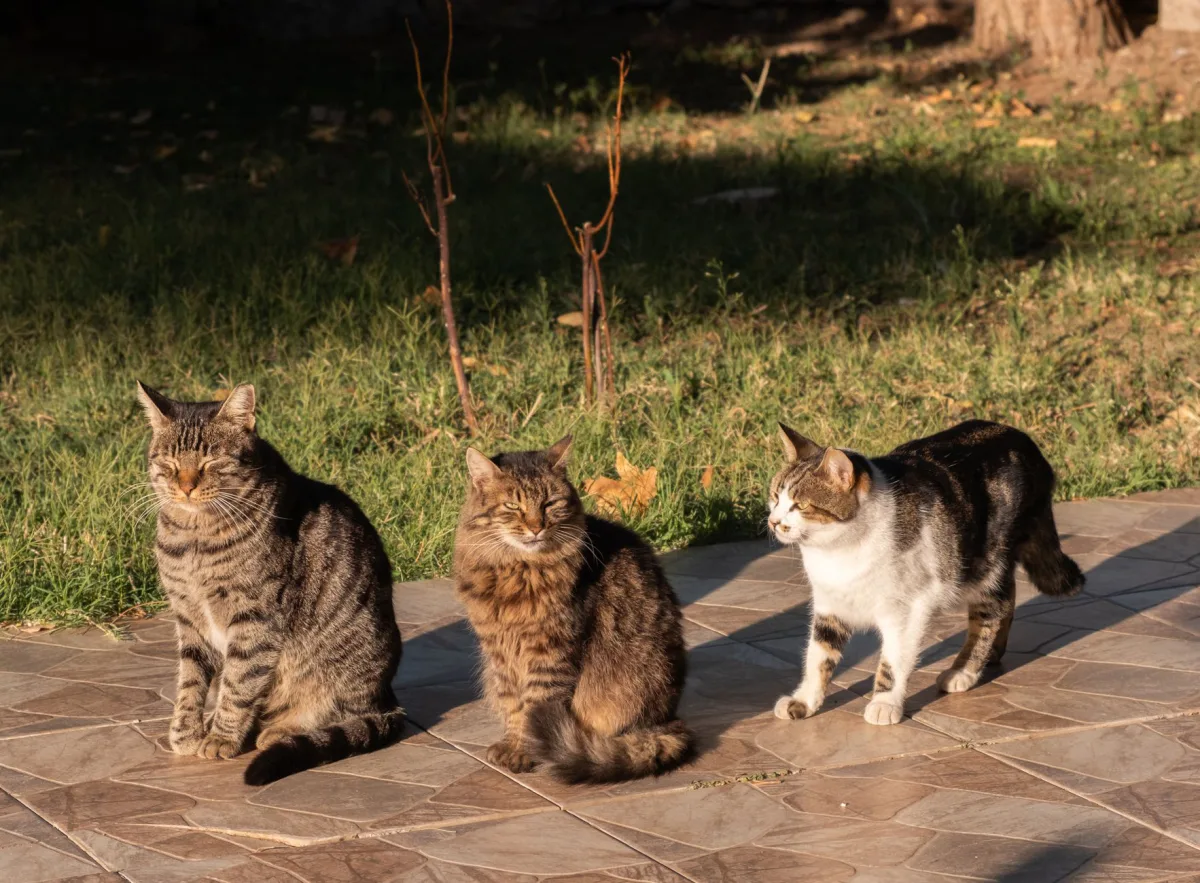
In multi-cat homes, odor is not linear with the number of cats exponentially increases — because the containers are used more and cats urinate on each other, spreading the smell. The basic rule does not change: number of cats + 1 container, distributing containers in different rooms, scooping and highly absorbent sand at least twice a day. Additionally, in homes with many cats, the smell is often a social tension indicator: urinating outside the container is the first sign of a problem with resource sharing.
After two cats, the equation changes. The order that works smoothly with one cat collapses with three cats. In this article, we cover both the technical and behavioral sides of managing odor in multi-cat homes.
Why does it increase exponentially?
- The load per container increases. If three cats use two bowls, each bowl will take in several times more waste per day.
- Repeated use. Cats urinate on each other's fresh waste; The bacterial contact area expands.
- Sand saturates faster. Absorbent capacity is shared; the same sand is consumed in a shorter time.
- The possibility of leaking urine increases. A dirty or occupied bowl is not used, the cat goes elsewhere.
- Marking behavior. If there is tension, cats may spray urine on walls and furniture; This is a different and more persistent smell than the litter box smell.
- Scattering increases. More digging, more sand out. See litter scatter.
Number and placement of containers
| Number of cats | Recommended litter box | Placement |
|---|---|---|
| 1 | 2 | Two different points |
| 2 | 3 | At least two different rooms |
| 3 | 4 | Different rooms, one may be on separate floor |
| 4 | 5 | Distributed, at least three rooms |
| 5+ | Number of cats + 1 | Distribution to every floor and area |
Placement is more important than number: Placing four bowls side by side creates the effect of one large bowl — for cats, this means “single source.” Distribute containers far apart, in different rooms and, if possible, on different floors. A dominant cat may control a single lane; Two separate regions make this impossible.
Avoid dead ends when choosing a container location: the cat wants to see an escape route when entering the container. Detail: Where should the litter box be placed? And How many cats and how many litter boxes?.
Multi-cat routine
- At least twice a day, scoop all containersSkipping one container breaks the entire chain.
- Maintain the litter depth5-7cm. In a multi-cat household, litter decreases faster; Check after each scooping.
- Do full changes more oftenAt shorter intervals than with a single cat. See frequency of change.
- Wash containers alternatelyInstead of washing them all on the same day, spread them out over the week; so there is always a clean container.
- Separate scoop for each containerIt reduces disease transmission. See litter scoop.
- Use a litter matScattered sand accumulates in a multi-cat household. See litter mat.
- Use the same sandDifferent litter between bowls may lead some cats to reject certain bowls.
Social tension and peeing outside the pot
The most persistent source of odor in multi-cat homes is not the litter box, but is urine passed out of the container. There is usually a behavioral reason behind this:
- Competition for resources. Insufficient bowl, water, food or rest area.
- Cap blocking. The dominant cat may prevent the other from reaching the container; This is often a silent and difficult to detect behavior.
- A new household member. A new cat or baby joining the house changes the balance.
- Change stress. Moving, furniture change, guest.
- Health problem. Painful urination alienates the cat from the container — it associates the container with pain.
Health first, behavior second. Any cat that starts urinating outside the container should first be evaluated by a veterinarian. Urinary tract problems are more common in multi-cat homes with stress, and what is thought to be a behavior may be medical.
International Cat CareIn multi-cat homes, the resources (litter box, water, food, bed, high spot) are sufficient in number and distributed defines it as a basic principle. Detail: The cat is confused about its toilet, stress and toilet.
Sand selection and consumption
In a multi-cat household, litter goes through a tougher test than in a single-cat household: more liquid, more odor, more frequent digging. There are three defining features here — absorbency, lump integrity And odor retention.
Disintegrated sand creates a second problem in a multi-cat household: when scooping, clean sand also disappears and consumption increases. For lump integrity clumping, for consumption account How much is 8 liters enough? See our articles.
Fragrance-freeness becomes especially important in a multi-cat household: scented litter that one cat tolerates may be rejected by another and head out of the container. Cat litter from olive pits does not contain perfume; Since it controls odor with activated carbon, it is unlikely to cause acceptance problems between containers. See scented or odorless?.
Consumption increases rapidly in households with three or more cats; 8 liter pack of four It both reduces the cost per liter and makes it easier to maintain the rule of using the same sand in all containers.
On the cost side, multi-cat households naturally tend to buy in bulk; for the conditions of this bulk purchase And prices Our articles show the way. Pay attention to storage conditions: excess stock will cause damage if stored poorly (how to store).
For homes with multiple cats
High absorbency and activated carbon make a difference in multiple uses. Cat litter from olive pits It is more economical in multiple packages.
Four-pack of cat litter for multi-cat homes triple pack olive pit cat litter See all cat litters
Frequently asked questions
How many litter boxes should there be in a house with multiple cats?
Number of cats + 1. Four containers for three cats. It is as important as the number that the containers are distributed in different rooms rather than side by side.
Is it enough to put the containers side by side?
No. Cats perceive side-by-side containers as a single source; One dominant cat can control them all. Distribute it in different rooms.
Why is there so much smell in a house with many cats?
The amount of waste per container increases, cats urinate on each other's fresh waste, and the litter becomes saturated faster. Additionally, the possibility of urinating outside the container increases.
One of my cats is peeing outside the bowl, what should I do?
Get a vet check first; Urinary tract problems are a common cause of this behavior. If there is no medical problem, review the number and distribution of containers and reduce resource competition.
Can I use a different type of sand for each container?
Not recommended. Different litters may cause some cats to reject certain bowls. It is safer to use the same sand in all containers.
Related articles
Tags for this post

The team that produces sand in our production facility in Ayvalık turns the most frequently asked questions in the field into a guide. Health-related sections are general information; It is not a substitute for a veterinary examination.